
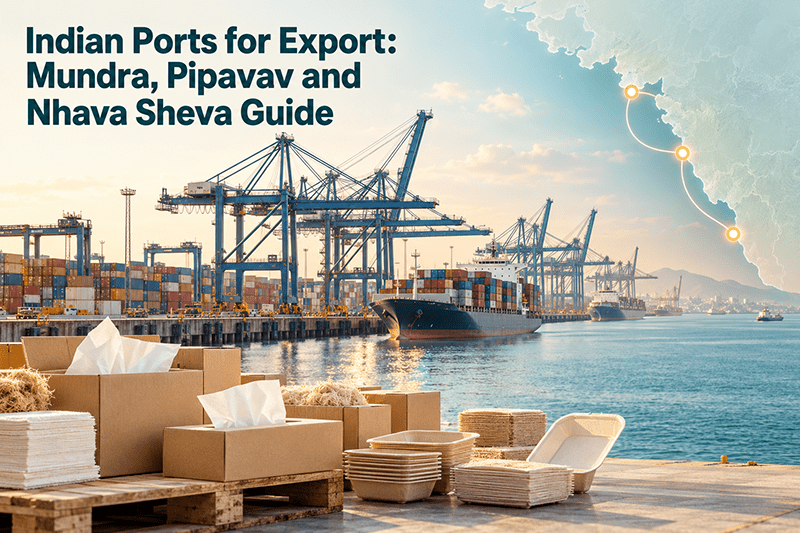
Why the port of loading matters to buyers
When you buy from a Gujarat manufacturer, choosing between Indian ports for export affects freight rates, sailing frequency, transit time and how quickly your container leaves the factory. Buyers often let the supplier pick, but understanding the options helps you compare quotes, especially on FOB terms where you or your forwarder book the vessel. Three west coast ports handle almost all of White Orchid shipments: Mundra, Pipavav and Nhava Sheva.
All three connect to main shipping lanes towards the Middle East, Europe, Africa, the Americas and Oceania. The differences lie in road distance from the factory, carrier choice, congestion patterns and the services that call at each port on your route.
Because the factory is at Santej near Ahmedabad, all three ports are within practical trucking distance, which gives buyers genuine flexibility. The right answer changes by destination and season, so it is worth reviewing the choice with your forwarder from time to time rather than fixing one port for every order.
Mundra port: the main Gujarat gateway
Mundra, in the Kutch district of Gujarat, is a large privately operated port with extensive container terminals and a wide choice of mainline services. For factories in central Gujarat, it is a practical road haul, and many global carriers offer direct or well connected services from Mundra to Europe, the Gulf, East Africa and North America. It is often the default port of loading for Gujarat exporters.
For buyers, Mundra usually means competitive freight and frequent sailings. Its size also brings good availability of 40 ft high cube equipment, which matters for light cargo such as toilet tissue rolls and bagasse tableware that need maximum volume.
Pipavav port: a Saurashtra alternative
Pipavav sits on the Saurashtra coast in Amreli district. It is smaller than Mundra, with fewer services, but it can offer shorter queues and a useful alternative when the larger ports are congested. Some carriers run services from Pipavav towards the Gulf, the Mediterranean and North America, and its rail links move containers from inland depots.
Pipavav is worth considering when your preferred carrier calls there, or when rates are better on a particular lane. Your forwarder can compare schedules for both Gujarat ports in a single enquiry.
Nhava Sheva (JNPT): India's busiest container hub
Nhava Sheva, also called JNPT or Jawaharlal Nehru Port, is in Navi Mumbai, Maharashtra. It is one of the busiest container ports in India and has the widest range of services and destinations. The road haul from central Gujarat is longer, which adds inland cost and time, but some routes, particularly to smaller or less common destinations, may only have direct services from Nhava Sheva.
For buyers, Nhava Sheva is most useful when a direct sailing saves a transhipment elsewhere, which can reduce both transit time and handling risk for light cartons. The trade off is a longer truck journey from Gujarat and occasional congestion at peak periods, so factory dispatch must be planned a few days earlier to meet the vessel cut off.
| Port | Location | Main strengths | Consider when |
|---|---|---|---|
| Mundra | Kutch, Gujarat | Many mainline services, good HC availability | Default for most destinations |
| Pipavav | Amreli, Gujarat | Less congestion, rail connectivity | Your carrier calls there or rates are better |
| Nhava Sheva (JNPT) | Navi Mumbai, Maharashtra | Widest range of services | Direct service needed to less common ports |
How Indian ports for export affect transit time and cost
Total time from factory to your warehouse includes road haul to the port, gate in before the vessel cut off, sea transit, transhipment where applicable, and destination clearance. Indicative sea transit from Gujarat to the Gulf can be around one to two weeks, and to Europe or North America several weeks. These ranges vary by carrier, route and season, so treat any schedule as indicative until the booking is confirmed.
Cost follows the same logic. A port with more direct services may offer a slightly higher inland haul but a lower ocean rate. Compare the total from factory gate to your door, not just the ocean freight line.
The best port of loading is rarely the closest. It is the one with a reliable direct service to your port at a total cost you can repeat every order.
Documents and customs at the port
Whichever port is used, export customs clearance in India follows the same process: a shipping bill filed electronically, commercial invoice, packing list and, where needed, a certificate of origin. For buyers in the UAE or Australia, a preferential origin certificate under the India UAE CEPA or India Australia ECTA may help reduce duty, so ask for it when placing your order.
- Commercial invoice showing product description, HS code and agreed Incoterm.
- Packing list matching carton counts and weights for each product line.
- Bill of lading issued by the carrier once the container is loaded.
- Certificate of origin, including preferential forms where a trade agreement applies.
- Product documents such as test reports or certificates your market requires.
Two practical points affect every port. First, the verified gross mass (VGM) of each container must be declared to the carrier before loading. Second, each vessel has a gate in cut off, usually a day or more before sailing. Missing it means the container rolls to the next vessel, so reliable factory dispatch and early document preparation matter as much as the port itself.
Choosing a port for mixed product orders
Mixed containers of tissue napkins, thermal rolls and bagasse containers with lids leave the factory as one sealed unit, so the port choice is the same as for a single product. What changes is equipment: a high cube is usually preferred for mixed paper loads, so the port with better high cube supply on your route often wins.
Urgent samples or small top up orders do not have to wait for a container. White Orchid can also ship by air for time sensitive consignments. Air freight costs far more per kilogram, so most buyers keep it for samples, launch stock or emergency replenishment, and move regular volumes by sea through the Gujarat ports.
Ship from Gujarat with White Orchid
White Orchid manufactures at Santej near Ahmedabad and ships through Mundra, Pipavav and Nhava Sheva on EXW, FOB, CFR, CIF and door delivery terms, by sea and by air. Tell us your destination port and preferred terms, and we will suggest a suitable port of loading and share a quote. Contact White Orchid on +91 9825109781 or [email protected], or learn more about us.
Frequently Asked Questions
Which Indian port is best for exporting from Ahmedabad?
For most destinations, Mundra is the practical first choice from Ahmedabad because of its road connectivity and wide carrier choice. Pipavav is a useful alternative, and Nhava Sheva suits routes that only have direct services from Mumbai.
Can I choose the port of loading on FOB terms?
Yes. On FOB terms you or your forwarder book the vessel, so you can name Mundra, Pipavav or Nhava Sheva as the port of loading. White Orchid then delivers the cleared container to that port before the cut off.
Does the port of loading change my import duty?
No. Import duty depends on HS classification, customs value and origin, not the Indian port used. A preferential origin certificate under agreements such as India UAE CEPA may affect duty, so check with your customs broker.
Are 40 ft high cube containers available at all three ports?
High cube equipment is generally available at Mundra, Pipavav and Nhava Sheva, but supply varies by carrier and season. Your forwarder or White Orchid will confirm equipment at booking, which matters for light tissue cargo.