
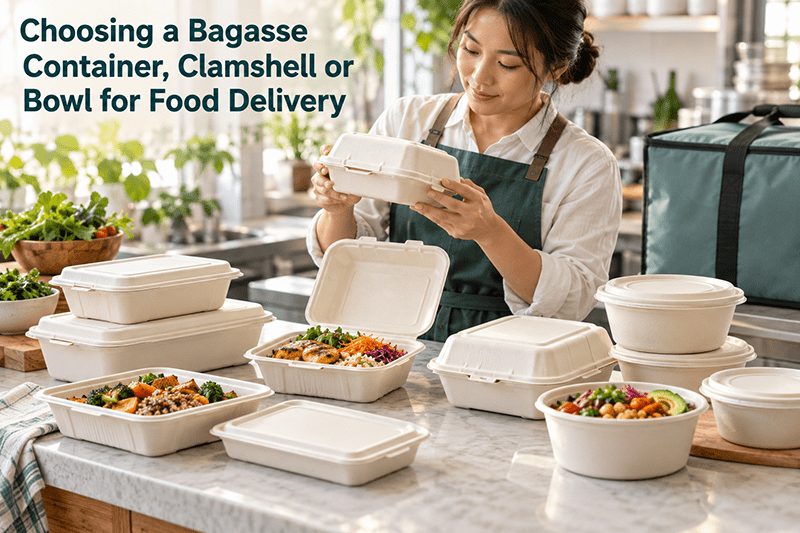
Why the right bagasse container for food delivery matters
Choosing the right bagasse container for food delivery affects how food arrives, how customers feel about the brand, and how much packaging a restaurant uses per order. A container that is too large lets food slide and cool. One that is too small leaks or crushes. With plastic restrictions spreading, many restaurants and cloud kitchens are switching to moulded sugarcane bagasse, and distributors need to recommend the right format for each menu.
Bagasse is moulded from sugarcane fibre left after juice extraction. It is biodegradable and compostable, handles hot and oily food well, and has a natural, clean look that suits eco conscious brands. The question is not whether to use bagasse, but which shape and size fits each dish.
Clamshells for burgers, sandwiches and snacks
Hinged clamshells are the classic takeaway box. The lid is attached, so there is nothing to lose, and the box closes firmly for stacking in delivery bags. White Orchid bagasse clamshells come in 6x6, 9x6 and 9x9 inch sizes, plus a 9x9 three compartment version. The 6x6 suits burgers and small snacks, the 9x6 fits sandwiches and wraps, and the 9x9 carries full meals.
The three compartment 9x9 clamshell is popular for combo meals where rice, a main dish and a side must stay separate. It keeps presentation neat on arrival and avoids sauces running into dry items, a common complaint in delivery reviews.
Clamshells stack well in insulated delivery bags, which helps riders carry several orders at once without crushing. For fried food, a slightly larger clamshell leaves space for steam to spread, which keeps items such as fries and pakoras crisper than a tightly packed box. Ask kitchens how long typical deliveries take before recommending a size.
Bowls for curries, noodles, salads and desserts
Open bowls suit dishes with sauce or depth. Bagasse bowls range from 120 ml square and smart bowls for dips, chutneys and desserts, through 180, 210 and 230 ml bowls for sides, to 350 ml bowls for curries, noodles, salads and rice dishes. For delivery, bowls are usually paired with a lid or placed inside a sealed outer bag.
For dine in and eat in counters, the 230 ml eat-in bowl works well for soups and desserts served on site, where a lid is not needed and presentation matters.
Small bowls also work as side containers inside a larger order. A 120 ml bowl of chutney or raita placed inside a 9x9 clamshell keeps sauces separate, which is often simpler than stocking a separate compartment box for every combination on the menu.
Bagasse containers with lids for liquid rich meals
Round and rectangular bagasse containers with lids are the closest replacement for plastic delivery tubs. Round 500, 750 and 1000 ml containers suit curries, dal, biryani, pasta and soups. Rectangular 500 and 750 ml containers fit rice and main course combinations and stack neatly in delivery bags. Matching lids help keep heat in and food secure during the ride.
Containers with lids also suit meal prep brands and caterers who pack food in advance, because they stack neatly in chillers and look clean when handed to the customer. The rectangular shape fits more units per delivery bag than round tubs of similar capacity.
| Menu item | Recommended format | Suggested size |
|---|---|---|
| Burgers and small snacks | Clamshell | 6x6 inch |
| Sandwiches and wraps | Clamshell | 9x6 inch |
| Combo meals | Three compartment clamshell | 9x9 inch |
| Curries, dal, soups | Round container with lid | 500 to 1000 ml |
| Rice and main dishes | Rectangular container with lid | 500 or 750 ml |
| Dips, chutneys, desserts | Small bowl | 120 to 180 ml |
Heat, oil and sauce: testing your bagasse container
Bagasse handles hot and greasy food better than most paper packaging, but every menu is different. Very thin gravies, long delivery times and heavy oil all test a container. Before switching a whole menu, ask for samples and run real delivery trials: pack the dish, leave it for your typical delivery time plus a margin, then check the base, lid fit and food temperature.
Buyers in Europe and North America should also ask for food contact and compostability documentation relevant to their market, such as test reports against EN 13432 or ASTM D6400, and check local rules on PFAS in food packaging.
The best takeaway box is the one that fits the portion. Right sizing a container protects the food, cuts packaging cost and makes the brand look careful.
Portion size and packaging cost
Oversized containers waste material and let food shift. Measure actual portion volumes for each dish, then choose the smallest container that holds it with a little headroom for the lid. Many restaurants find they can reduce from three or four container sizes to two, which simplifies ordering, storage and staff training.
- Measure real portion volumes before choosing container sizes for each dish.
- Use compartment clamshells where sauces must stay separate from dry food.
- Choose containers with lids for curries, soups and other liquid dishes.
- Run delivery trials with samples before switching the whole menu over.
- Limit the range to a few sizes to simplify stock and ordering.
Fewer sizes also help the supply side. A distributor who knows that a customer uses only two clamshell sizes and one container can forecast demand accurately, hold the right safety stock, and deliver on time every week, which is what keeps restaurant accounts loyal.
Serving cloud kitchens and delivery brands as a distributor
Cloud kitchens often run several brands from one kitchen, so they value a supplier who can cover every format. Distributors who stock clamshells, bowls and containers with lids, plus bagasse plates and trays for events, can supply a complete takeaway range. Adding napkins to every order increases basket size with almost no extra effort.
Mixed containers make this practical for importers. Rather than filling a whole container with one clamshell size, you can combine several bagasse formats with tissue products and adjust quantities as you learn which items move fastest in your market.
Source bagasse containers from White Orchid
White Orchid moulds clamshells, bowls, plates and containers with lids from sugarcane bagasse pulp at Santej, Gujarat, and ships worldwide on EXW, FOB, CFR, CIF and door delivery terms. Private label on cartons is available with an MOQ. Contact White Orchid on +91 9825109781 or [email protected] to request samples and a quote for your delivery range.
Frequently Asked Questions
Which bagasse clamshell size is best for burgers?
The 6x6 inch clamshell is usually the best fit for a single burger or small snack. For burgers served with fries, many outlets move up to the 9x6 or 9x9 inch clamshell so both fit comfortably.
Can bagasse containers hold hot curry and soup for delivery?
Bagasse handles hot and oily food well, and round containers with lids suit curries and soups. Test with your own recipes and delivery times, especially for very thin gravies, before switching the full menu.
What is the difference between a clamshell and a container with lid?
A clamshell has an attached hinged lid and suits dry or semi dry food such as burgers and combos. A container with a separate lid seals better for liquid rich dishes such as curries, dal and soups.
Are bagasse food containers certified compostable?
Bagasse is biodegradable and compostable by nature. For market claims, ask your supplier for test reports against standards such as EN 13432 or ASTM D6400, and check local food contact requirements.