
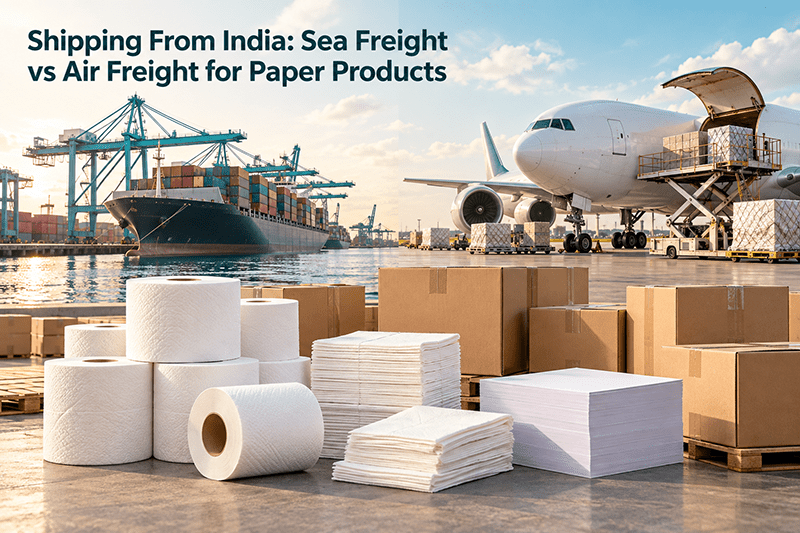
Shipping From India: Why Freight Mode Matters for Paper Products
For importers of tissue, copy paper, thermal rolls and bagasse tableware, freight is one of the biggest parts of landed cost. When shipping from India, the choice between sea freight and air freight affects price, speed, stock planning and even the condition of goods on arrival. Paper products have a particular challenge: many are light but bulky. Understanding how each mode charges for space and weight helps you choose the right option for each order.
Sea Freight From India: The Default for Paper Products
Sea freight is the standard choice for commercial volumes of paper products. Containers are charged per box rather than per kilo, which suits bulky items such as toilet rolls and kitchen towels. White Orchid ships from Gujarat's Mundra and Pipavav ports and from Nhava Sheva (JNPT) near Mumbai. These ports have frequent sailings to the Gulf, Africa, Europe, the Americas and Oceania, often with transhipment at hub ports.
The trade-off is time. Sea freight takes longer and needs planning around sailing schedules, cut-off dates and destination clearance. For regular replenishment of fast moving lines, that is manageable once you set reorder points correctly.
Sea freight costs also move with the market. Rates on some trade lanes can change significantly within a few months, driven by demand, fuel prices and route disruptions. Ask for quotations with validity dates, compare CIF offers from your supplier with FOB plus your own forwarder, and review freight assumptions in your landed cost model every quarter.
FCL vs LCL Sea Freight for Paper Products
A full container load (FCL) gives you a dedicated container, usually 20 foot, 40 foot or 40 foot high cube. For tissue, the high cube container is popular because extra height means more cartons per box, lowering freight cost per unit. Less than container load (LCL) lets you share space, charged mainly by volume. LCL suits trial orders, but handling at consolidation warehouses adds cost and time, and can increase the risk of carton damage.
Tissue products usually fill a container by volume long before they reach its weight limit, a situation shippers call cubing out. Copy paper is the opposite: it is dense and can reach the weight limit first. Combining heavy copy paper with light tissue in one container can use both space and weight more efficiently, lowering freight cost across the whole order.
Air Freight From India: When Speed Justifies the Cost
Air freight is charged on chargeable weight, which is the higher of actual weight and volumetric weight. Because tissue is light and bulky, its volumetric weight is usually far higher than its actual weight, which makes air freight expensive for these products. Air works best for samples, urgent top-up stock, launch quantities for a new customer or dense, high value items. Thermal POS rolls are often a better fit for air than tissue.
A sensible compromise is to use air freight for a small first consignment so your sales team can start meeting customers, while the main order follows by sea. This shortens the time to first sale without paying air rates on the full volume. Ask your supplier to pack the air portion separately with clear labelling, so it can clear customs quickly.
| Factor | Sea freight | Air freight |
|---|---|---|
| Charged by | Container or volume | Chargeable weight, often volumetric |
| Cost per unit | Low for bulky goods | High for tissue and tableware |
| Indicative transit | Weeks, varies by route | Days, varies by route |
| Best for | Regular stock, full containers | Samples, urgent or small orders |
| Planning needed | High, sailing schedules | Lower, frequent flights |
Indicative Transit Times From Indian Ports
Transit times vary by carrier, route, transhipment, port congestion and season, so treat any figures as indicative. As a rough guide, port to port sea transit from western India to Gulf ports is often around one to two weeks, to Europe and the UK often around three to six weeks, and to North and Latin America often longer. Air freight is typically a few days airport to airport. Allow extra time for customs clearance and inland delivery.
Door delivery and CIF quotes include the ocean leg, but always ask which port of discharge the price covers. Inland transport from the port to your warehouse can be substantial in large countries, and it is often left out of quick comparisons between suppliers.
Route disruptions can extend sea transit at short notice. Build a safety margin into your stock levels, particularly ahead of peak seasons for your customers, rather than relying on the fastest published schedule.
For paper products, freight is bought by the cubic metre. The more cartons you fit in a container, the more competitive your landed price becomes.
Protecting Paper Products in Transit
Moisture is the main risk for paper on long sea voyages. Condensation inside containers can soften cartons and mark products. Strong master cartons, poly bag inner packing, desiccants and correct stowage all help. Palletised loads are easier to handle but take space, while floor loading maximises carton count. Discuss the right balance with your supplier. Clear carton labels with item code and batch number simplify receiving and stock rotation.
Insurance is worth arranging for every shipment, whichever mode you choose. Under CIF terms the seller arranges minimum cover, while under FOB or CFR the buyer should organise it. Paper products are vulnerable to water damage, so check that your policy covers wetting and condensation, and photograph cartons on arrival before signing delivery papers.
Practical Freight Tips for Importers From India
Getting freight right is part skill, part routine. These habits help importers keep costs under control and stock flowing.
- Use high cube containers for tissue to maximise cartons and lower unit cost.
- Combine several product categories in one container to reach full container volumes.
- Reserve air freight for samples, launches and urgent top-ups of dense items.
- Agree Incoterms clearly, such as FOB or CIF, before confirming each order.
- Build a stock buffer to cover transit delays and seasonal peaks at destination.
Mixed containers work well for distributors building a full range. A single container can carry tissue napkins, copy paper, thermal rolls and bagasse plates, letting smaller buyers reach full container economics without overstocking any one item.
Ship Paper Products From India With White Orchid
White Orchid manufactures tissue, copy paper, thermal rolls and bagasse tableware at Santej, near Ahmedabad, and ships by sea from Mundra, Pipavav and Nhava Sheva, and by air. We offer EXW, FOB, CFR, CIF and door delivery terms, and can help plan container loads across product categories. We are appointing distributors and importers worldwide. Visit our infrastructure page, then contact us or WhatsApp +91 9825109781.
Frequently Asked Questions
Is sea freight or air freight better for tissue paper?
Sea freight is usually better for tissue because it is bulky and light. Air freight charges on volumetric weight, which makes tissue expensive to fly. Use air only for samples or urgent small quantities.
Which Indian ports does White Orchid ship from?
White Orchid ships by sea from Mundra and Pipavav in Gujarat and from Nhava Sheva (JNPT) near Mumbai, and also offers air freight, on EXW, FOB, CFR, CIF and door delivery terms.
Can I mix different paper products in one container?
Yes. Many distributors combine tissue napkins, toilet rolls, copy paper, thermal rolls and bagasse tableware in one container to reach full container volume without overstocking a single item.
How long does sea freight from India to Europe take?
Port to port transit is often around three to six weeks, but it varies by carrier, route, transhipment and season. Add time for customs clearance and inland delivery at destination.