
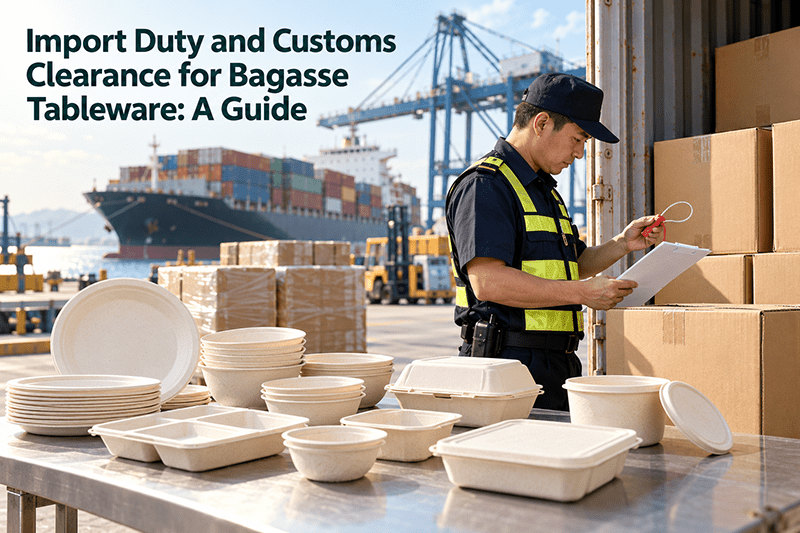
Why Import Duty and Customs Clearance for Bagasse Tableware Need Planning
Bagasse tableware is simple to use but can be tricky at the border. It is a food contact product, it is often sold with environmental claims and it sits in a broad tariff heading. Planning import duty and customs clearance for bagasse tableware before you place an order helps you price accurately, prepare the right documents and avoid goods sitting at the port while questions are answered. This guide covers classification, documents and a practical clearance sequence.
HS Classification of Bagasse Tableware
Bagasse plates, bowls, clamshells and containers are moulded or pressed from sugarcane pulp, so they are usually classified under HS heading 4823, covering other paper and cellulose articles, and often under subheading 4823.70 for moulded or pressed pulp articles. The full national code adds further digits, which vary by country. Confirm the exact code on your official tariff, such as EU TARIC, US HTS or the UK Trade Tariff, or ask a customs broker.
Avoid describing the goods loosely as paper plates or disposable items on your invoice. A description such as moulded sugarcane bagasse pulp plate, 10 inch, packed 50 pieces per sleeve, gives customs officers what they need and supports your chosen code.
If you import several shapes, such as round plates, compartment trays, bowls and clamshells, check whether your national tariff splits them further. Most will sit together, but lids, containers and trays sometimes raise questions. Asking your broker to confirm each item before the first shipment is cheaper than correcting a declaration after goods have been released and customs has opened an enquiry.
How Import Duty on Bagasse Tableware Is Worked Out
Import duty is normally calculated by applying the tariff rate for your code to the customs value of the goods. Depending on the country, that value may include international freight and insurance. Import VAT or GST is usually added afterwards. If your country has a trade agreement with India that covers this product, a lower preferential rate may apply when a valid certificate of origin is presented. Check whether any trade remedy duties apply to moulded pulp goods in your market.
Build these figures into a landed cost sheet per item, not only per container. A container of bagasse tableware can hold many different products with very different values per carton, so allocating duty, freight and taxes by value or volume gives you a realistic cost per sleeve. That is the number you need when quoting caterers, wholesalers and retail chains in your market.
Food Contact Documents Buyers and Authorities Expect
Because bagasse plates and food containers touch food, many markets expect evidence of food contact safety. In the EU, materials must comply with Regulation (EC) 1935/2004, and buyers commonly ask for a declaration of compliance and migration test reports. In the US, FDA food contact rules apply, and several states restrict PFAS in food packaging. Saudi Arabia uses the SABER conformity platform for many imported goods.
Customs officers may not ask for all of these documents at the border, but food safety inspectors, retail buyers and large caterers often will. Having them ready before the goods arrive shortens clearance if a query comes up and helps you sell faster once stock is in your warehouse.
| Document | Usually provided by | Purpose |
|---|---|---|
| Commercial invoice | Exporter | Value, description, terms of sale |
| Packing list | Exporter | Cartons, weights and item quantities |
| Bill of lading or air waybill | Carrier or forwarder | Proof of shipment and ownership |
| Certificate of origin | Exporter via authorised agency | Claim preferential duty where available |
| Food contact test reports | Manufacturer or test lab | Evidence of food safety compliance |
Customs Clearance Steps for Bagasse Tableware
Clearance follows a similar pattern in most countries. Your broker files the import declaration using the invoice, packing list and transport document, customs assesses duty and taxes, you pay them and the goods are released, sometimes after a physical inspection. Wooden pallets usually need ISPM 15 treatment marks, and some countries require pre-arrival filings. Work through these steps early with your broker.
Timing matters as much as paperwork. Many brokers prefer to receive documents a few days before the vessel arrives so they can prepare the declaration and flag issues early. If your market requires pre-arrival security or safety filings, those deadlines may fall before the ship even leaves India. Share your shipping schedule with your broker as soon as the booking is confirmed.
- Confirm the HS code and duty rate with your broker before placing the order.
- Check whether your market requires food contact registration or conformity certificates.
- Ask the exporter for a certificate of origin if a trade agreement applies.
- Send draft invoice and packing list to your broker for review before shipment.
- Arrange duty and tax payment funds so goods are not held at port.
Most customs delays are not caused by the goods. They are caused by vague descriptions, missing documents or a code chosen at the last minute.
Choosing Incoterms That Suit Your Clearance Setup
Your choice of Incoterms 2020 affects who handles what. Under EXW or FOB, you or your forwarder manage freight and clearance at destination, giving you control over costs. Under CFR or CIF, White Orchid arranges sea freight to your port, and you handle import clearance. Door delivery can suit smaller importers who prefer one supplier to coordinate transport to their premises. Whatever the term, import duties and local taxes need clear agreement in the contract.
Practical Tips for First Time Bagasse Importers
Start with a trial shipment of your fastest moving items, such as round plates, clamshells and bowls. Use it to test clearance time, landed cost and customer response before committing to larger volumes. Keep a file for each shipment with the declaration, duty paid, documents submitted and any customs queries. That record makes future shipments faster and helps if customs later audits your classification.
It also helps to agree with your broker who will answer technical questions if customs or food inspectors query the goods. Keep the manufacturer's specification sheets and test reports in one shared folder so answers can be sent the same day, rather than waiting for documents to travel between time zones.
Import Bagasse Tableware From White Orchid
White Orchid manufactures bagasse plates, bowls, clamshells and containers with lids at Santej, near Ahmedabad, with ISO 9001, ISO 14001, ISO 22000, GMP and FSC certifications. We ship by sea from Mundra, Pipavav and Nhava Sheva, and by air, on EXW, FOB, CFR, CIF and door delivery terms. See our certificates, then contact us or WhatsApp +91 9825109781 to discuss documents for your market.
Frequently Asked Questions
What HS code is used for bagasse tableware?
Bagasse tableware is usually classified under HS heading 4823, often subheading 4823.70 for moulded or pressed pulp articles. The full national code varies, so confirm it on your official tariff or with a customs broker.
Do I need food contact certificates to import bagasse plates?
Many markets expect evidence of food contact safety, such as an EU declaration of compliance and migration test reports, or documents supporting US FDA compliance. Requirements vary, so confirm with your broker or regulatory adviser.
Can I pay lower duty on bagasse tableware from India?
Possibly, if your country has a trade agreement with India covering this product and the goods meet rules of origin. You will need a valid certificate of origin from the exporter to claim the preferential rate.
How long does customs clearance for bagasse tableware take?
With correct documents and a clear HS code, clearance can be quick. Inspections, missing food contact documents or classification queries cause delays. Timing varies by country and port, so ask your broker for local expectations.