
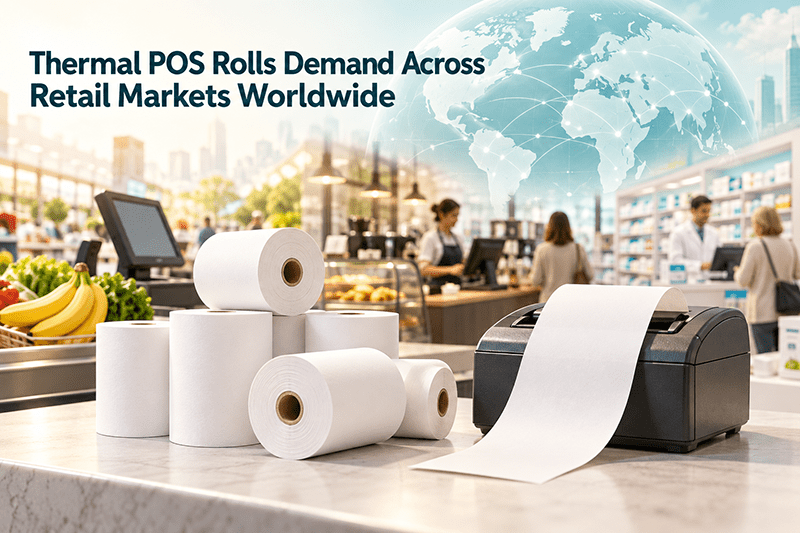
Why thermal POS rolls demand stays strong
Digital receipts are growing, yet thermal POS rolls demand remains solid across retail markets worldwide. Supermarkets, pharmacies, restaurants, fuel stations, parking systems and courier counters still print receipts, kitchen tickets, labels and card slips every day. In many countries, tax rules or customer habits favour a printed record. Wherever new shops open and card payments spread, the number of printers using thermal paper grows with them.
Thermal printing is popular because it is simple. There is no ink or ribbon, printers are compact and fast, and rolls are cheap to replace. This makes thermal paper the default for point-of-sale systems, handheld payment terminals and mobile printers carried by delivery staff. Even in markets moving towards e-receipts, merchants keep printing merchant copies, order tickets and end of day reports.
Growth in emerging markets is especially important. As retail formalises in Africa, the Middle East, Latin America and South Asia, small shops install billing software and receipt printers for the first time, often linked to tax invoicing systems. Mobile payment terminals spread quickly among small traders. Each new device becomes a recurring buyer of rolls, which is why distributors in these regions see steady repeat orders once they win dealer relationships.
Where thermal POS rolls demand comes from
Demand is spread across many sectors. Organised retail and supermarkets consume large volumes of wide rolls at checkouts. Restaurants and cloud kitchens print bills and kitchen order tickets. Banks, payment providers and their agents supply narrow rolls for card terminals. Fuel stations, transport operators, parking systems, lotteries and logistics companies add steady demand. Each sector has its own preferred sizes and buying channels, which shapes how distributors stock and sell.
Seasonality and events also affect orders. Retail peaks such as festival seasons, holiday shopping and sales events increase receipt volumes, and restaurants print more tickets during tourist seasons. Distributors who plan stock ahead of these peaks, and who keep buffer stock of the fastest selling sizes, avoid the stock-outs that push retailers towards competitors. A simple sales history by size and month makes this planning much easier.
| Roll size | Typical use | Main buyers |
|---|---|---|
| 3 1/8 inch x 230 ft | Retail POS receipt printers | Supermarkets, retail chains, POS dealers |
| 3 1/8 inch x 265 ft or 150 ft | Restaurant bills, kitchen tickets | Restaurants, cafes, cloud kitchens |
| 2 1/4 inch x 50 ft or 85 ft | Card terminals, handheld printers | Payment providers, banks, merchants |
| 2 1/4 inch x 150 ft | Taxi meters, parking, mobile billing | Transport and service operators |
Buyer segments and channels for thermal rolls
Most thermal POS rolls reach end users through POS equipment dealers, stationery and office supply wholesalers, packaging distributors and online marketplaces. Large retail chains and payment providers often buy under contract, with fixed sizes and delivery schedules. Smaller shops buy by the box from local dealers. An importer who supplies dealers with a full size range, consistent quality and quick delivery usually builds a loyal base.
Branding creates extra value. Retail chains, restaurant groups and banks often want their logo, promotions or support numbers printed on the back of rolls. White Orchid offers logo printing on thermal rolls with an MOQ, which lets distributors win contracts that compete on service rather than only on price. Private label cartons and poly packs help distributors build their own recognisable brand in the market.
Regulations affecting thermal POS rolls demand
Chemical safety shapes buying decisions. The European Union restricted the use of BPA in thermal paper from 2020, and many retailers elsewhere now specify BPA free paper in their procurement policies. White Orchid thermal rolls are BPA free, which helps importers meet these expectations. Buyers may also ask about image life, sensitivity and compatibility with specific printer models, so keep technical data sheets ready for tenders and dealer enquiries.
HS codes and duty for thermal paper rolls
Thermal paper rolls are often classified under HS heading 4811 or 4823, depending on the form, width and whether the paper is cut to size. Ask your customs broker to confirm the exact code for each size, then check duty on your official tariff tool, such as EU TARIC, US HTS through USITC, the UK Trade Tariff or your national customs, and add freight and clearance costs.
Paperwork should describe rolls accurately. Commercial invoices and packing lists should state the width, length, core size and quantity for each size, which helps customs officers and your broker classify goods consistently. When you add logo printed or private label rolls, update the description and check that the classification does not change, especially if the printed matter becomes a significant feature of the product.
A receipt roll is a small item, but a checkout that runs out stops sales instantly. Reliable supply is what retailers really buy from a thermal roll distributor.
Quality points buyers check before importing
Good thermal rolls print sharp, dark images without streaks, feed smoothly without jamming and match the stated length. Check core size, outer diameter and length against printer specifications, because short rolls quickly damage a distributor's reputation. Ask for samples in each size, test them on common printers in your market, and confirm packing details such as rolls per carton and carton dimensions for container planning.
Storage also affects quality. Thermal coatings react to heat, sunlight, humidity and some plastics, so rolls should travel and stay in sealed cartons in a cool, dry place. Distributors that rotate stock using FIFO and avoid storing rolls near heaters or PVC film keep print quality consistent, which reduces complaints and returns from retailers and restaurants.
- Stock the full range of 3 1/8 inch and 2 1/4 inch sizes.
- Confirm BPA free status and keep technical data sheets for every tender.
- Test samples on the printer models most common in your market.
- Check roll length, core size and outer diameter against stated specifications.
- Offer logo printed rolls to retail chains, restaurants and payment providers.
Source thermal POS rolls from White Orchid
White Orchid manufactures BPA free thermal rolls in 3 1/8 inch x 230 ft, 265 ft and 150 ft, and 2 1/4 inch x 50 ft, 85 ft and 150 ft sizes at Santej, Gujarat. We can combine rolls with A4 copy paper or tissue in mixed containers. Contact White Orchid on +91 9825109781 or [email protected] to request samples and distributor terms.
Frequently Asked Questions
Which thermal roll size sells most in retail markets?
The 3 1/8 inch width, especially 230 ft length, is widely used in retail POS printers. The 2 1/4 inch width is common in card terminals and handheld printers, so most distributors stock both.
Are White Orchid thermal rolls BPA free?
Yes, White Orchid thermal POS rolls are BPA free. This helps importers supply retailers and markets that restrict BPA in thermal paper or specify BPA free receipts in procurement policies.
Can thermal rolls be printed with a company logo?
Yes. White Orchid offers logo printing on thermal rolls with an MOQ. Retail chains, restaurants and banks often use the back of rolls for branding, promotions or customer support numbers.
How should thermal paper rolls be stored by distributors?
Keep thermal rolls in sealed cartons in a cool, dry and shaded area, away from heaters, sunlight, PVC film and chemicals. Use FIFO so older stock is sold first and print quality stays consistent.