
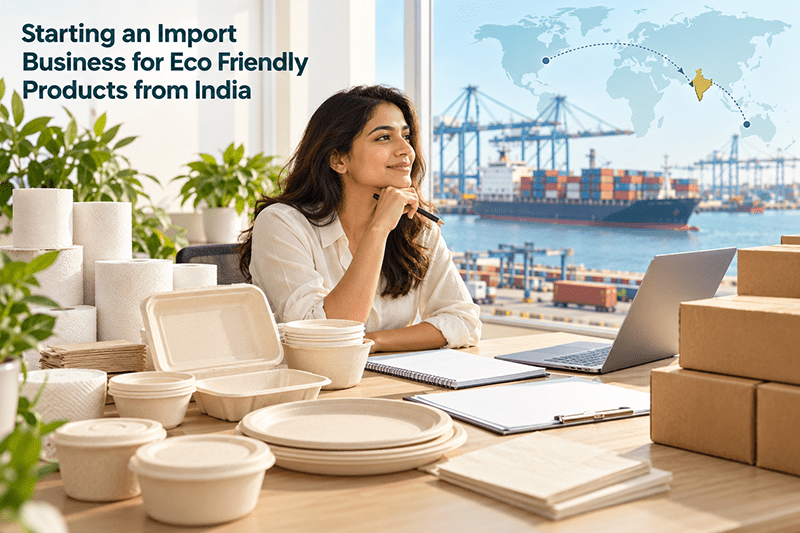
Why start an import business for eco friendly products
Starting an import business for eco friendly products is attractive because regulation and customer preference are both moving away from single-use plastic. The EU Single-Use Plastics Directive, India's own single-use plastic ban, plastic bag bans in countries such as Kenya and Rwanda, and the UAE's phased ban on single-use plastic products all push buyers towards alternatives such as bagasse tableware and paper based products.
India is a practical source. Manufacturers such as White Orchid produce bagasse tableware, tissue and paper products at scale, with export experience and flexible shipping terms. Gujarat has good access to west coast ports, and buying several categories from one manufacturer lets a new importer fill a container without dealing with multiple suppliers.
Step 1: research your market and customers
Begin with who will buy. Restaurants, cloud kitchens, caterers, hotels, event companies and retailers each want different products. Visit potential customers, check which packaging they use now, and note prices on local wholesale sites. Look at local rules on single-use plastic, because a ban or tax on plastic items can create immediate demand for bagasse plates and clamshells.
Keep the first range focused. Three to six products that you understand well are easier to sell than a large catalogue you cannot explain. Talk to at least ten potential customers before ordering, and ask what volumes they buy each month.
Step 2: understand HS codes and duty
Every product is classified under an HS code, which decides import duty and any special rules. Bagasse tableware is usually classified under heading 4823, often 4823.70 for moulded pulp articles. Tissue products usually fall under 4818, and copy paper under 4802. Confirm the exact code for your product and check the rate on your official tariff tool, such as EU TARIC, US HTS, UK Trade Tariff or your national customs, or ask a customs broker.
Also check whether a trade agreement applies. Buyers in the UAE and Australia may benefit from India's CEPA and ECTA agreements with a valid certificate of origin.
Step 3: check compliance and documentation
Eco products often carry claims that must be supported. For food contact items, check your market's rules, such as EU Regulation (EC) 1935/2004 or US FDA food contact requirements, and local limits on PFAS in food packaging. For compostability claims, ask the supplier for test reports against EN 13432 or ASTM D6400. In Saudi Arabia, check requirements on the SABER platform.
Labelling matters too. Some markets require country of origin, importer details or specific language on packs. Private label cartons are the easiest place to meet these rules. Make a checklist with your customs broker before artwork is finalised, because changing printed packaging after production is slow and expensive.
Step 4: work out your landed cost
Landed cost is the true cost of goods in your warehouse. It adds product price, freight, insurance, duty, taxes, clearance and local delivery. The illustrative example below uses round, hypothetical numbers only. Real figures depend on market, freight and duty, so build your own sheet with actual quotes.
| Cost element | Illustrative amount | Source of real figure |
|---|---|---|
| Goods value (FOB India) | 10,000 | Supplier quotation |
| Ocean freight and insurance | 2,500 | Forwarder quote, varies by season |
| Import duty and taxes | Per tariff | Official tariff tool or broker |
| Clearance and local delivery | 800 | Customs broker and haulier |
Once you have landed cost, divide it by the number of sellable units to get cost per unit. Compare this with local wholesale prices to see whether the business works. If the margin looks thin, try a different product mix, a larger container, or a different Incoterm before giving up.
Step 5: choose a supplier and shipping terms
Look for a manufacturer rather than a trader, with relevant certifications and clear export terms. White Orchid holds ISO 9001, ISO 14001, ISO 22000, GMP and FSC certifications and ships on EXW, FOB, CFR, CIF and door delivery. Beginners often prefer CIF or door delivery, which reduce the logistics they must manage themselves while they learn. Ask each shortlisted supplier for certificates, a product specification sheet and references to its export process before you commit.
Request samples, test them with real customers, and plan a first mixed container. Combining bagasse clamshells, bowls and tissue napkins spreads risk across products while keeping full container efficiency.
Import businesses rarely fail on product. They fail on landed cost surprises and slow sales. Research both before the first container sails.
Step 6: sell, store and reorder
Arrange a dry warehouse before the container arrives, and line up first customers so stock starts moving immediately. Track which items sell fastest, then adjust the next order. Many importers settle into a regular cycle once they know monthly movement for each product.
- Research customers and local plastic rules before choosing your first products.
- Confirm HS codes and duty rates on your official tariff tool.
- Collect food contact and compostability documents your market expects.
- Build a landed cost sheet from real quotes, not rough estimates.
- Start with a mixed container and reorder based on actual sales.
Cash flow deserves attention. Goods are usually paid for before or around shipment, while customers may pay on credit. Plan working capital for at least two containers, one in stock and one at sea, so you never run short while waiting for payments to come in.
Step 7: build your brand and grow
Once sales are steady, consider private label packaging. Your own brand on bagasse cartons and tissue packs builds recognition with customers and makes it harder for competitors to replace you. White Orchid offers private label on poly bags, boxes and master cartons with an MOQ, plus logo printing on napkins and thermal rolls.
Growth usually comes from adding categories and customers rather than cutting price. An importer who starts with bagasse clamshells can add tissue napkins, then thermal rolls and kitchen towels, until each delivery covers most of a customer's consumables. Some go on to appoint sub distributors in nearby cities, spreading the imported volume across a wider territory.
Start your eco friendly import business with White Orchid
White Orchid manufactures bagasse tableware, tissue, thermal rolls and copy paper at Santej, Gujarat, and is appointing importers and distributors worldwide. We support new importers with samples, mixed containers, private label and export documents. Contact White Orchid on +91 9825109781 or [email protected], or learn more about us.
Frequently Asked Questions
What eco friendly products are easiest to import from India first?
Bagasse clamshells, plates, bowls and containers are popular starting points because plastic restrictions create clear demand. Tissue napkins pair well with them, giving food service customers a complete order from one importer.
How do I find the import duty on bagasse tableware?
Bagasse tableware is usually classified under HS heading 4823, often 4823.70. Confirm the exact code and rate on your official tariff tool, such as EU TARIC or US HTS, or ask a customs broker.
Do I need a licence to import eco friendly products?
Requirements vary by country. Most need a registered business and an importer number, and food contact products may need extra documentation. Check with your national customs authority or a customs broker before your first order.
Which shipping term is best for a first time importer?
Many first time importers choose CIF or door delivery so the supplier handles more of the logistics. White Orchid offers EXW, FOB, CFR, CIF and door delivery, so you can move to FOB as you gain experience.