
What Sugarcane Bagasse Is and Why It Suits Tableware
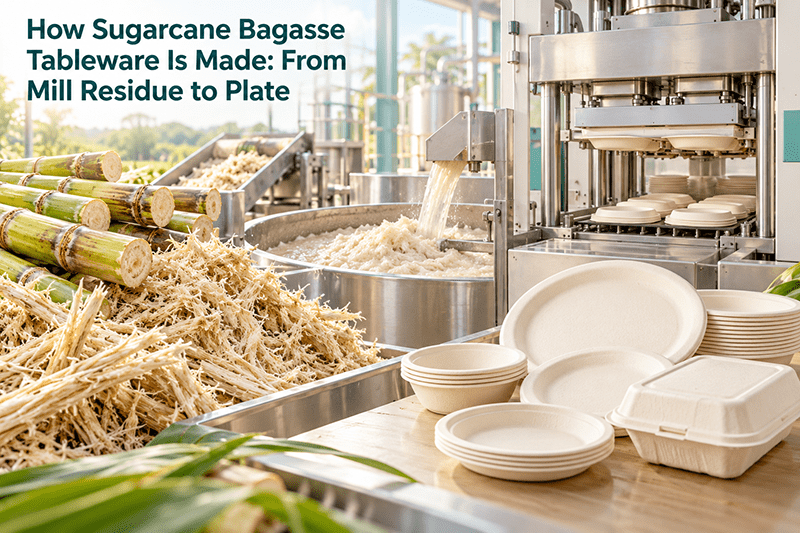
Sugarcane bagasse is the fibrous residue left after sugar mills crush cane to extract juice. For decades much of it was burnt in mill boilers or simply dumped. Today a growing share is pulped and moulded into plates, bowls, clamshells and containers. The short, strong cellulose fibres bond well under heat and pressure, which is why sugarcane bagasse tableware can hold hot curries, oily snacks and wet salads without the plastic lining older paper plates needed.
Because bagasse is a by-product of an existing crop, no extra land is farmed to produce it. That gives distributors a simple, honest story for customers who want to move away from plastic and foam: the plate started life as part of a sugarcane plant, and it can return to the soil under the right composting conditions.
Step 1: Collecting and Preparing Bagasse Fibre
The process starts at the mill. After juice extraction, moist bagasse contains usable fibre, leftover sugar and pith, the fine spongy material from the core of the cane. Pith weakens moulded products, so it is usually separated out. The remaining fibre is washed to remove residual sugars and soil, then stored or processed into pulp. Clean, consistent raw fibre is the first quality control point, because impurities at this stage later show up as dark specks or weak spots.
Step 2: Pulping Bagasse Into a Mouldable Slurry
Prepared fibre is converted into pulp, often supplied as dry pulp boards that tableware factories buy and store. At the moulding plant, the boards are broken down in a pulper with water to form a thin slurry. Depending on the product, the pulp may be bleached for a bright white finish or left unbleached for a natural beige tone. Food grade additives for water and oil resistance are dosed into the slurry at this stage.
Buyers should ask exactly what those additives are. Several US states now restrict PFAS in food packaging, and the EU food contact framework under Regulation (EC) 1935/2004 requires that materials do not transfer harmful substances to food. A reliable supplier will share additive declarations and migration test reports on request, so importers can match the product to the rules of their own market before stock arrives.
Step 3: Wet Forming the Bagasse Pulp on Mesh Moulds
Forming is where bagasse pulp becomes a recognisable plate or bowl. A mould with a fine metal mesh surface is dipped into, or fed with, the slurry. Vacuum draws water through the mesh and leaves an even mat of fibre shaped like the final product. Mould design controls wall thickness, compartment depth and rim strength, which is why a 9 compartment plate, a meal tray and a 350 ml bowl each need their own dedicated tooling.
Mould count also affects lead times. A factory running several sets of tooling for popular sizes, such as 10 inch round plates or 9x9 clamshells, can switch between items quickly, while unusual shapes may need planning. When you build a product list for your market, sticking mainly to standard sizes usually means faster production and simpler repeat orders for your warehouse.
Step 4: Hot Pressing and Drying the Moulded Pulp
The wet fibre mat is transferred to a heated press. Matching upper and lower moulds apply heat and pressure together, driving out the remaining moisture and fusing the fibres into a smooth, rigid shape. This hot pressing step gives moulded pulp tableware its dense surface and clean edges. Temperature, pressure and cycle time are tuned for each item, and inconsistent settings are the usual cause of warped plates, blistered surfaces or soft corners.
Step 5: Trimming, Hygiene Treatment and Quality Checks
After pressing, excess fibre around the rim is trimmed so every piece has a clean edge and stacks neatly. Many producers pass finished items under UV lamps for surface hygiene before packing. Quality teams then check weight, dimensions, visual defects and leak resistance on samples from each batch. A food safety management system such as ISO 22000 gives buyers confidence that these checks follow a documented routine rather than guesswork on a busy shift.
| Stage | What happens | What buyers should check |
|---|---|---|
| Fibre preparation | Bagasse is depithed, washed and stored | Consistent colour and cleanliness |
| Pulping | Pulp is mixed with water and food grade additives | Additive declarations and PFAS status |
| Wet forming | Vacuum moulds shape the fibre mat | Uniform wall thickness |
| Hot pressing | Heat and pressure dry and fuse the fibre | Rigidity, flatness, no warping |
| Finishing | Trimming, hygiene treatment, inspection | Clean rims and batch test records |
Step 6: Packing Bagasse Tableware for Export
Finished products are counted into sleeves or poly bags, then packed into master cartons. For export, carton strength and moisture protection matter, because tableware may spend weeks in a container on humid sea routes. Importers who sell under their own brand can ask for private label on poly bags, boxes and master cartons, subject to a minimum order quantity. Clear carton marking with item code, count and batch number speeds up receiving at the destination warehouse.
The quality of a bagasse plate is decided long before it reaches the press: clean fibre, the right additives and well made moulds do most of the work.
What the Bagasse Tableware Process Means for Importers
Understanding how bagasse tableware is made helps you write better specifications and ask sharper questions. Instead of ordering a generic 10 inch plate, you can specify weight per piece, colour, compartments, carton count and required test documents. That clarity reduces disputes and keeps repeat orders consistent. White Orchid manufactures biodegradable plates, biodegradable bowls, clamshells and containers with lids moulded from sugarcane bagasse pulp.
Before your first order, it helps to run a short checklist so the samples you approve match the containers you eventually receive.
- Ask for piece weight and dimensions for every item you plan to import.
- Request additive declarations and food contact migration test reports before placing orders.
- Confirm whether bleached white or natural colour suits what your customers expect.
- Agree carton count, carton size and palletisation before production is scheduled.
- Check compostability test reports against EN 13432 or ASTM D6400 for your market.
Work With White Orchid on Bagasse Tableware Supply
White Orchid is a manufacturer at Santej, near Ahmedabad in Gujarat, with ISO 9001, ISO 14001, ISO 22000, GMP and FSC certifications. We ship by sea from Mundra, Pipavav and Nhava Sheva, and by air, on EXW, FOB, CFR, CIF or door delivery terms. We are appointing distributors and importers in India and overseas. Review our certificates, then contact us or WhatsApp +91 9825109781 for samples and a quotation.
Frequently Asked Questions
What raw material is used to make bagasse plates?
Bagasse plates are made from sugarcane bagasse, the fibre left after sugar mills extract juice. The fibre is cleaned, pulped, moulded under vacuum and then hot pressed into plates, bowls, clamshells and containers.
Why are some bagasse plates white and others brown?
White bagasse tableware uses bleached pulp, while beige or brown items use unbleached pulp. Both are moulded the same way. The choice is mostly about customer preference and presentation, so confirm the colour when you place your order.
Do bagasse plates contain chemical coatings?
Many bagasse products include food grade additives for oil and water resistance. Ask your supplier for additive declarations and migration test reports, and check PFAS rules in your market, because several US states restrict PFAS in food packaging.
Can bagasse tableware be printed or private labelled?
The moulded items themselves are normally plain, but White Orchid offers private label on poly bags, boxes and master cartons, subject to a minimum order quantity, so importers can sell under their own brand.