
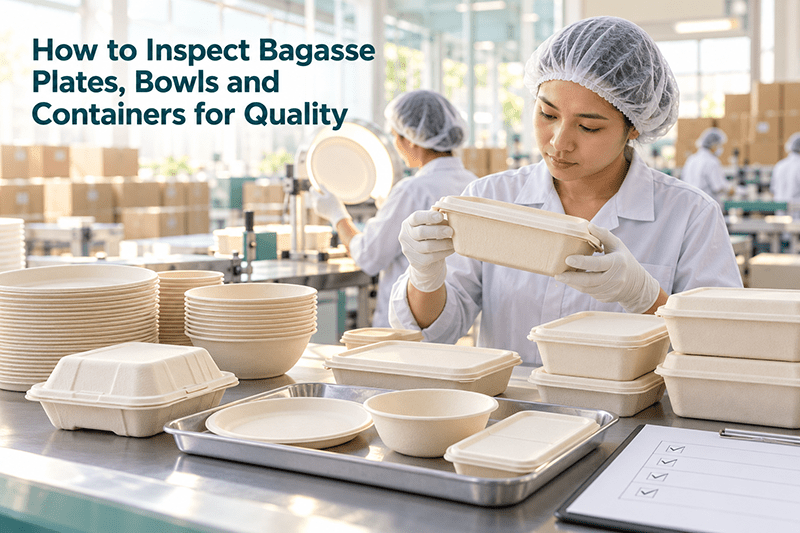
Why you should inspect bagasse plates and bowls before selling
Food service customers judge bagasse tableware in seconds: a plate that bends under curry or a clamshell that leaks in a delivery bag loses the account. That is why importers should inspect bagasse plates, bowls and containers for quality, both at sample stage and before each shipment. The tests below need only a scale, a ruler, hot water, hot oil and a microwave, and they reveal most problems before products reach your customers.
White Orchid moulds its tableware from sugarcane bagasse pulp, and the products are biodegradable and compostable. Like any moulded fibre product, quality depends on pulp preparation, moulding pressure, drying and trimming, so consistent checks are the best way to confirm that bulk production matches the approved sample.
Check weight and thickness to inspect bagasse plates
Weight is the quickest indicator of strength. Weigh ten pieces of each item on an accurate scale and compare the average with the approved sample and specification. Lighter pieces usually mean thinner walls, which bend or leak sooner. Measure wall thickness at the rim and base, and check that the diameter or length matches. For bagasse plates, press gently on the rim while holding the base to test rigidity.
Also check weight consistency across the batch. A wide spread between the lightest and heaviest pieces suggests uneven moulding, even when the average looks correct.
Also measure the depth of bowls and the compartments of trays against the specification, because small changes in depth affect capacity. A 350 ml bowl that holds noticeably less than stated will cause complaints from restaurants that portion food by volume.
Oil resistance test
Place hot cooking oil, or an oily curry, on a plate or in a bowl and leave it for the time a meal typically sits before eating or during delivery. Then check the underside for dark spots or seepage. Compare with the reference sample under the same conditions. Ask the supplier how oil resistance is achieved and request related documents, especially if your market restricts PFAS in food packaging, as several US states do.
Water resistance and liquid holding test
Fill bowls and containers with hot water and leave them for a set period. Look for softening, leaks at the base or corners and any change in shape. Then tip the item gently to check the rim stays firm. For soups and gravies, repeat with hot liquid food. Record the time before any softening appears, so you can advise customers realistically about how long food can be held.
Test cold and chilled use too if your customers store salads or desserts in the fridge. Condensation can soften some pieces over time, so check the base and rim after a few hours of refrigeration, and note the results in your product guide for buyers.
| Test | How to do it | What to look for |
|---|---|---|
| Weight and thickness | Weigh ten pieces, measure rim and base | Consistent with approved sample |
| Oil resistance | Hot oil or oily food for a set time | No seepage or dark spots underneath |
| Water resistance | Hot water or soup held for a set time | No leaks, softening or shape change |
| Finish and hygiene | Visual check in good light, rub surface | Smooth, clean, no specks or loose fibres |
| Lid and clamshell fit | Close, shake gently, tilt with liquid | Secure closure, hinge intact, no spill |
| Heat use | Microwave with food as supplier advises | No scorching, warping or odour |
Finish, hygiene and odour
Examine each item under good light. Surfaces should be smooth, evenly coloured and free from black specks, foreign particles, cracks, burrs and rough trimmed edges. Rub the surface with a clean finger to check for loose fibres. Smell a freshly opened sleeve: there should be no strong or unusual odour. Also inspect sleeves and cartons for cleanliness, since tableware touches food directly and must reach the kitchen in hygienic condition.
Check packing counts and sleeve quality as well. Count pieces in several sleeves, confirm carton marks match the packing list and look for crushed corners. Sleeves should be sealed so products stay clean and dry from factory to kitchen.
Keep a simple record of every test, with photos, dates and batch numbers. Over several shipments, these records show whether quality is stable and give you clear evidence if you ever need to raise an issue with the supplier.
Lid fit, hinges and stacking
For containers with lids, check that lids press on firmly and stay in place when the container is tilted with liquid inside. For clamshells, open and close the hinge several times to make sure it does not crack, and check that the locking tab holds. Stack and de-nest several pieces to confirm they separate easily, which matters on a busy service counter.
Heat use and microwave checks
Ask the supplier for the recommended heat use range, then test within it. Heat food in the microwave for a typical reheating time and check for scorching, warping or odour. Try a hot, oily meal in a closed clamshell to see how steam affects the lid. Keep claims such as microwave safe or oven safe to what your tests and supplier documents support, and follow your market's food contact rules.
For compostability claims, ask for test reports against EN 13432 or ASTM D6400, and for food contact, ask for reports under Regulation (EC) 1935/2004 or FDA rules as relevant to your market.
- Weigh ten pieces of each item and compare with the approved sample
- Test oil resistance with hot oily food for a realistic holding time
- Hold hot water or soup in bowls and containers to check leaks
- Open and close clamshell hinges repeatedly and tilt lidded containers with liquid
- Heat food in a microwave within the supplier's advised range before claiming
Bagasse tableware is judged in real kitchens, not on spec sheets. Test it with hot, oily and wet food the way your customers will, and quality problems reveal themselves early.
Source inspected bagasse tableware from White Orchid
White Orchid supplies bagasse round and compartment plates, meal trays, bowls, clamshells and containers with lids, moulded from sugarcane bagasse pulp. Buyers may request samples for testing and photos or inspection before shipment. We are appointing importers and distributors in India and overseas. Send your product list and market details through our contact page, email [email protected] or WhatsApp +91 9825109781 to receive samples.
Frequently Asked Questions
How do I test oil resistance when I inspect bagasse plates?
Place hot oil or an oily curry on the plate for a realistic holding time, then check the underside for seepage or dark spots. Compare the result with the approved reference sample tested under the same conditions.
Can bagasse bowls and containers be used in a microwave?
Many bagasse products can be used for reheating, but ask the supplier for the advised heat use range and test with your own food. Only make microwave claims supported by your tests and documents.
Why does the weight of bagasse tableware matter?
Weight reflects how much fibre is in each piece, which affects rigidity and resistance to oil and liquids. Lighter pieces than the approved sample often bend or leak sooner, so weigh samples from every batch.
How should I check bagasse clamshell quality?
Open and close the hinge several times, check the locking tab holds, and tilt the closed clamshell with hot, saucy food inside. Look for cracks at the hinge, lid lift or any leakage.